A Better Way to Do Massage School
Massage School Doesn't Have to Be Expensive or Inconvenient. We Think There's a Better Way.
How Alpha School of Massage in Jacksonville is challenging traditional education with affordable tuition, guided hybrid learning, and outstanding national licensing examination results.
In This Article:
- A Better Way
- Does Massage School Really Need to Cost So Much?
- Hybrid Education Is Not Self-Taught Education
- Other Healthcare Professions Are Rethinking Education, Too
- What About Results? Let's Talk About the MBLEx.
- Entrance Requirements
- Let's Be Honest: Hybrid Learning Isn't for Everyone
- Staying Power
A Better Way
For more than 30 years, Alpha School of Massage has helped people in Jacksonville, Florida, prepare for careers in massage therapy. Since opening our doors in 1992, we've watched the profession grow, technology advance, and students' needs change.
Along the way, we've learned something important:
Just because something has always been done a certain way doesn't mean it's the best way to do it.
That belief led us to make a significant change in 2020: we embraced hybrid massage therapy education, combining guided online instruction with hands-on classroom training and supervised clinical experience.
But we didn't simply take our traditional classroom lectures and put them online.
We began a journey of research, experimentation, learning, and continuous improvement. We wanted to discover how to make massage therapy education more convenient, more accessible, and more affordable without sacrificing educational quality.
Six years later, we're proud of what we've accomplished.
Our students are achieving exceptional results on the national licensing examination. They outperformed Florida’s average first-time pass rate by nearly 27 percentage points and the national average by more than 20 percentage points in 2025.1
We accomplish this while keeping costs down.
Does Massage School Really Need to Cost So Much?
Let's begin with something that matters to almost everyone considering a new career: money.
According to published tuition comparisons for the 2024–2025 academic year, average tuition and fees for massage therapy programs nationwide were about $12,148, plus $1,132 for books and supplies.2 In Florida, average tuition and fees were approximately $10,948.3
That's a substantial investment, particularly for someone considering a second career, raising a family, or trying to improve their financial future.
We think prospective students deserve more options.
At our Jacksonville campus, we offer two hybrid massage therapy programs designed around different priorities.
| Program comparison | 501-Hour Program | 650-Hour Program |
|---|---|---|
| Primary advantage | Speed | Affordability |
| Program hours | 501 | 650 |
| Tuition structure | $8,100 total program cost | $149 monthly |
| Completion | As little as 20 weeks | Typically 8–10 months |
| Learning format | Guided hybrid | Guided hybrid |
| Financial approach | Enrollment and kit included | No long-term tuition contract |
Our 501-hour program costs just $8,100, including the enrollment fee and required student supply kit. That's approximately 33% below the published national average tuition and fees alone. The hybrid approach offers additional value by reducing the amount of time a student must be on campus.
Our 650-hour program offers something additional.
What If You Could Attend Massage School for Just $149 a Month?
Imagine preparing for a new career without committing yourself to thousands of dollars in tuition debt. That’s what our 650-hour program was designed to make possible.
Students pay $149 per month, and the program typically takes eight to ten months to complete.
Here is what students can expect to pay:
-
One-time enrollment fee: $150
-
Required student supply kit: $299
-
Monthly fees: $149
For a student making eight to ten monthly payments, that works out to approximately $1,641–$1,939, including the enrollment fee and kit. That’s approximately 82–85% less than the published average tuition and fees in Florida and a remarkably affordable pathway into a new profession.
But perhaps the most important difference isn't the price.
Our 650-hour program is contract-free.
Students aren't locked into a long-term tuition obligation. If someone decides massage therapy isn't the right career, faces unexpected financial difficulty, or simply needs to change direction, that student can leave without owing additional payments.
We believe that matters.
Someone exploring a new career shouldn't have to worry about continuing to pay for an education they're no longer receiving.
How can we make this possible?
A significant part of the answer is our student massage clinic.
Students enrolled in the 650-hour program complete extensive hands-on practice, including 300 supervised clinic massages. Clients pay affordable fees for these services, helping support the cost of operating our educational program. It's an arrangement that benefits everyone. Students gain valuable practical experience, the community receives access to affordable massage services, and we can keep tuition exceptionally low.
We believe education should open doors, not create unnecessary financial barriers.
If 8 to 10 months is too long, our other program is designed to be quick.
Our 501-Hour Program: For Students Who Want to Get Started Sooner
Of course, affordability isn't everyone's first priority. Some students want to transition into a new profession as quickly as possible. They may be ready to commit to an accelerated schedule and begin their careers sooner.
That's why we also offer our 501-hour hybrid massage therapy program.
For a total program cost of $8,100, including enrollment and supply kit fees, students can complete their education in as few as 20 weeks, compared with the typical eight-to-ten-month timeline of our 650-hour program.
The program begins with three intensive weeks of five-day-per-week attendance. After that, students generally attend campus two or three days each week while completing guided online coursework. This arrangement provides an intensive hands-on foundation followed by greater scheduling flexibility.
For students whose priority is speed, the 501-hour program offers a practical pathway toward professional licensure.
Hybrid Education Is Not Self-Taught Education
One of the biggest misconceptions about hybrid learning is that students are simply teaching themselves.
We respectfully disagree.
At Alpha, our students don't have to choose what subjects to study, find their own instructional materials, design their own lessons, or decide whether they've mastered the material. We provide the curriculum. We organize the lessons. We guide the educational process. And we evaluate student progress.
Our programs include video instruction, reading assignments, timed quizzes, live final examinations, and opportunities for additional study sessions. Students are responsible for completing their work, just as they would be in a traditional classroom. But completing assignments independently isn't the same thing as teaching yourself.
Consider how traditional education works.
An instructor lectures. Students listen, take notes, read their textbooks, study, and prepare for examinations. Much of that foundational knowledge can be delivered through carefully designed online instruction, allowing students to review difficult concepts, revisit lectures, and study around their other responsibilities.
Students come to the campus for the training that truly requires in-person instruction. They practice massage techniques, develop palpation skills, learn proper body mechanics, interact with clients, and receive hands-on supervision.
Massage therapy is a hands-on profession. We would never suggest that someone could become a competent therapist simply by watching videos.
But does every lecture need to happen in a classroom at a particular time?
We don't think so.
We believe classroom time should be spent doing what massage classrooms do best: teaching hands-on skills and safe practices for the next generation of massage therapists and their clients.
Other Healthcare Professions Are Rethinking Education, Too
Massage therapy isn't the only healthcare profession exploring different ways to deliver education. Nursing programs have adopted various combinations of online instruction, traditional classroom teaching, simulation, and supervised clinical experiences. These developments reflect an important distinction: learning foundational knowledge and developing practical clinical skills are not always the same educational activity.
For example, the National Council of State Boards of Nursing has researched how well-designed clinical simulation can complement traditional nursing education.4 Although simulation differs from online instruction, the research shows that healthcare education can evolve while maintaining a focus on practical competency and patient safety.
That's the same principle guiding our approach.
We use technology to deliver organized academic instruction while preserving the hands-on training essential to developing professional massage skills. Our objective isn't to replace instructors with computers. It's to use educational technology thoughtfully so instructors and students can focus their time together on activities that benefit most from personal interaction.
What About Results? Let's Talk About the MBLEx.
Affordable tuition and convenient schedules are valuable benefits. But they don't mean much if students aren't prepared for professional licensure.
The Massage & Bodywork Licensing Examination, commonly called the MBLEx, is a nationally recognized examination used by state regulators to evaluate whether candidates possess the knowledge needed for entry-level massage practice. The Federation of State Massage Therapy Boards (FSMTB) develops and administers the examination.
We are proud of how our Jacksonville students have performed on this exam.
Here's a look at our reported historical MBLEx pass rates:
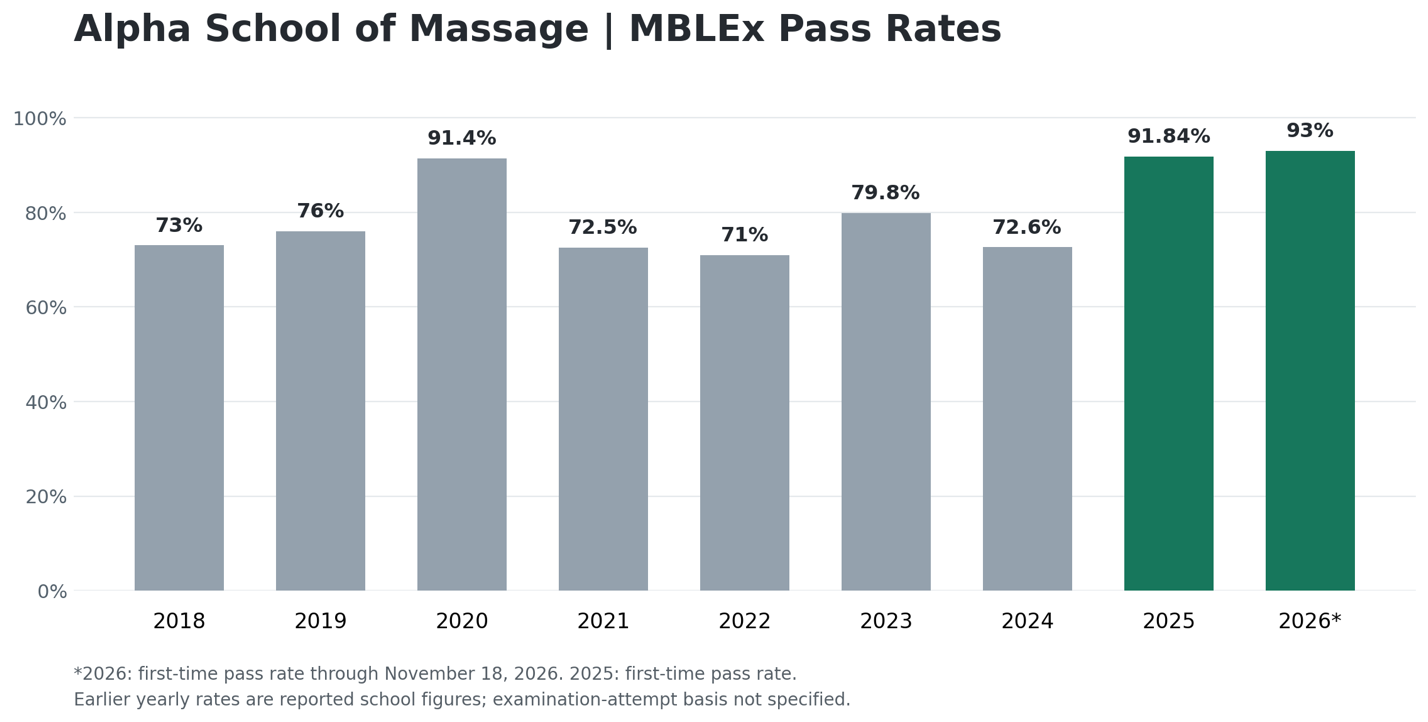
Source: Alpha School of Massage, Jacksonville, historical examination records.5
There's a story behind these numbers.
In 2020, the COVID-19 pandemic disrupted education everywhere. It was also the year we transitioned to hybrid learning. Our 91.4% pass rate that year was exceptional. But we want to be transparent about something: 2020 wasn't a normal year. The pandemic created difficult circumstances for many students. We believe the unusually high commitment of those who remained contributed significantly to that year's results.
We can't attribute that success entirely to hybrid education.
In fact, the next several years reminded us that creating an effective hybrid program requires much more than delivering lessons online. We maintained numbers similar to those in pre-COVID years.
We believed we could do better, so we continued researching, adjusting our curriculum, refining our instruction, and developing better ways to support students. Our results weren't consistently outstanding. We had challenges, and we learned from them. But we kept improving.
And in 2025, we saw a significant achievement.
Alpha Versus Florida and the Nation: Official 2025 Results
According to our official 2025 MBLEx School Performance Report, issued by the FSMTB, our Jacksonville campus achieved a 91.84% first-time pass rate. Of the 49 first-time MBLEx examinations administered to our students, 45 resulted in passing scores.
How does that compare with other test takers?
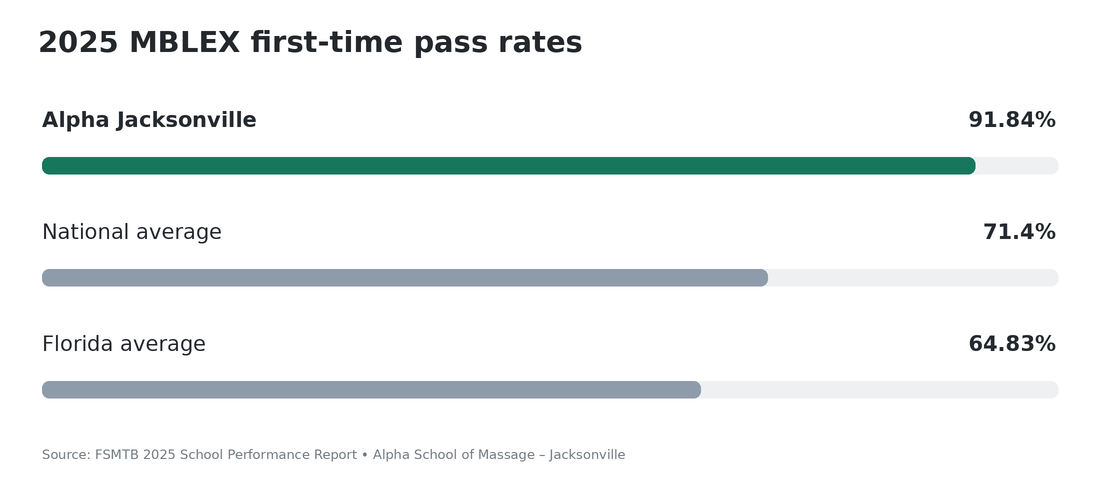
Our students' first-time pass rate exceeded the Florida average by nearly 27 percentage points and the national average by more than 20 percentage points. That's a comparison we're especially proud of because all three figures cover the same calendar year and measure first-time examination performance.
The Success Continued in 2026
As of November 18, 2026, our Jacksonville campus reports a 93% first-time MBLEx pass rate for the year. That represents continued strong performance following our 2025 results.
Does this prove hybrid education is automatically better than traditional classroom education?
Of course not. Student commitment, preparation, academic support, and other factors contribute to examination results. But we believe these outcomes provide substantial reason to challenge the assumption that students must receive all their instruction in a traditional classroom to succeed.
And there's something else prospective students should know about our admissions practices.
Entrance Requirements
We Don't Require an Entrance Exam to Protect Our Pass Rates
We believe educational outcomes should be considered alongside a school's admission practices. Some educational institutions use entrance examinations or selective academic screening to identify applicants most likely to succeed.
At Alpha, we don't require an entrance examination. We don't screen students according to their predicted likelihood of passing the MBLEx simply to make our pass rates look better.
Our philosophy is different.
We want to provide people who meet our enrollment requirements with a meaningful opportunity to learn a new profession. That doesn't mean every student will succeed, or that massage therapy school is easy.
It means we believe the responsibility of educators is to teach, guide, challenge, and prepare students—not merely select those who appear most likely to perform well on an examination.
Let's Be Honest: Hybrid Learning Isn't for Everyone
We believe strongly in hybrid education, but we also recognize its challenges. Some students thrive in traditional classrooms. They prefer a fixed daily schedule, regular face-to-face lectures, and the structure of attending school every day.
For those students, hybrid education may require adjustment.
It demands personal responsibility.
Students must manage their time, complete assignments, maintain consistent study habits, and arrive prepared for their hands-on instruction. Students who struggle with time management or procrastination may find that difficult.
We're not going to pretend otherwise. But traditional education presents its own challenges.
Consider a parent with young children, someone working full-time, or someone who has spent 20 years in another profession and wants to change careers. Attending classes five days a week for months may simply be unrealistic.
Should those responsibilities prevent someone from pursuing a new career?
We don't think so.
Our hybrid approach lets students complete parts of their education outside the classroom without removing the in-person instruction needed to develop professional massage skills.
It's not necessarily an easier education, but it is a more flexible way to learn.
And for many students, that flexibility can make the difference between pursuing a new career and giving up on the possibility altogether.
Staying Power
More Than 30 Years in Jacksonville. Still Looking for Better Ways to Teach.
When Alpha School of Massage opened in 1992, massage therapy education looked very different. Online learning platforms, streaming video instruction, and digital assessments weren't part of the everyday educational experience. But times change. Technology improves. And schools have opportunities to rethink how they serve students.
We believe schools should be willing to learn, too.
Our transition to hybrid education in 2020 began a process of questioning assumptions, researching possibilities, testing different approaches, and improving how we teach.
We haven't stopped.
Today, our Jacksonville campus offers two hybrid pathways:
A 501-hour program for speed, with an all-inclusive $8,100 program cost and completion possible in as little as 20 weeks.
A 650-hour program for affordability, with payments of $149 per month and no long-term tuition contract.
Both combine guided instruction with hands-on practical training and preparation for professional licensure. And our students' results demonstrate that affordable, flexible education can produce excellent examination outcomes.
We're not suggesting that every traditional massage school is doing something wrong. But we're willing to challenge an assumption that has shaped education for generations:
If students can receive quality instruction, develop the skills necessary for professional practice, and achieve outstanding licensing examination results with greater flexibility and at a lower cost, why should schools insist on doing things the way they've always been done?
At Alpha School of Massage, we think there's a better way. And we're proud to be helping build it right here in Jacksonville.
Ready to Begin Your Massage Therapy Career?
Whether your priority is completing school quickly or finding an affordable way into a new profession, we'd love to show you what's possible.
Explore our Jacksonville campus and learn more about our 501-hour accelerated program and 650-hour affordable hybrid program.
Your new career may be more accessible—and more affordable—than you imagined.
Footnotes
-
Federation of State Massage Therapy Boards, 2025 MBLEx School Performance Report, Alpha School of Massage – Jacksonville, January 1–December 31, 2025. ↩
-
College Tuition Compare, Massage Therapy/Therapeutic Massage Vocational Program Tuition Comparison, 2024–2025. https://www.collegetuitioncompare.com/compare/tables/vocational-program/massage-therapy-therapeutic-massage/ ↩
-
College Tuition Compare, Florida Massage Therapy Vocational Program Tuition Comparison, 2024–2025. https://www.collegetuitioncompare.com/compare/tables/?program=massage-therapy-therapeutic-massage&state=FL ↩
-
National Council of State Boards of Nursing, National Simulation Study ↩
-
Alpha School of Massage, Jacksonville, historical examination and tuition records, 2018–2026. ↩